
This free coffee shop loyalty card template is built around the familiar “buy nine, receive the tenth eligible item” mechanic. Treat that wording as a starting point, not a recommendation for every café. Change the target, reward, eligible purchase and terms after checking your own costs.
The download contains:
- an A4 front sheet with eight 85 x 55 mm card fronts;
- a duplex-aligned A4 back sheet with ten stamp positions;
- 3 mm bleed around each card and crop marks at the trim edge;
- a one-page setup and print guide; and
- an editable SVG source file for changing the copy, colour and terms.
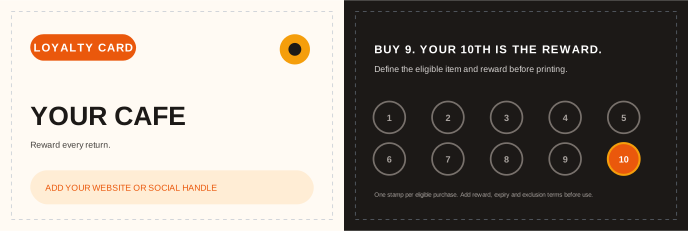
The SVG can be imported into Figma, Canva, Illustrator or Inkscape. If your printer wants a particular PDF standard, colour profile or outlined fonts, export the edited artwork to the printer’s specification.
Loyalty card dimensions and print setup
The finished card is 85 x 55 mm, a common UK business-card size. The artwork extends 3 mm beyond every trim edge, so each front and back is 91 x 61 mm including bleed.
Use these settings when handing the design to a printer:
| Setting | Recommended starting point |
|---|---|
| Finished size | 85 x 55 mm |
| Bleed | 3 mm on every edge |
| Safe area | Keep important text at least 4 mm inside the trim |
| Colour | Ask the printer whether it requires CMYK |
| Images | 300 dpi at final printed size |
| Paper | Uncoated stock if customers will receive physical ink stamps |
| Corners | Square by default; confirm any rounded-corner radius |
| Proof | Print one sample at 100% before ordering a full run |
Do not select “Fit to page” when printing the supplied A4 PDF. That changes the card dimensions. Print at actual size or 100%, then measure one trimmed card.
How many stamps should a coffee loyalty card have?
Eight to ten purchases is familiar, but there is no universal best number. The right target balances four things:
- Customer pace: Can a typical repeat customer reach the reward while the programme still feels alive?
- Reward value: Is the reward desirable enough to influence a future visit?
- Café cost: Can the café afford the direct cost at the expected completion and redemption rate?
- Staff clarity: Can the rule be explained and applied in one sentence?
A target of ten with the tenth item free produces a simple customer-facing ratio: nine paid eligible items for one reward. If the paid and rewarded items have the same menu price, the apparent reward value is about 10% across the ten-item cycle. That is not the same as the café’s cost, because the direct ingredient and packaging cost differs from the selling price.
A simple reward-cost estimate
Use:
Expected monthly reward cost = completed cards x redemption rate x direct cost per reward
Example assumptions:
- 80 cards reach the target in a month;
- 85% of completed rewards are redeemed; and
- the direct cost of the eligible reward is £1.05.
The estimate is:
80 x 0.85 x £1.05 = £71.40 per month
That figure still does not prove the programme is profitable. Compare it with the contribution from visits that would not otherwise have happened, the software or print cost, staff time and any misuse. Avoid claiming every member visit is incremental.
What to put on the front
The front should help a customer recognise the café and understand what the card is for. Keep it spare:
- café name or logo;
- “loyalty card” or another plain label;
- one short brand line if it adds meaning; and
- the website or social handle only if customers will use it.
Do not fill the front with the full legal terms. Put operational rules on the back and make the complete terms available at the counter or online.
What to put on the back
The back needs to answer the questions that cause disagreements:
- Which purchases earn a stamp?
- Is it one stamp per item or per transaction?
- What is the exact reward?
- Are premium sizes, extras or alternative milks included?
- Does the card expire?
- Can cards or stamps be combined?
- What happens on refunds?
- Can the reward be exchanged for cash?
- Where can the customer read the full terms and privacy information?
A concise example could be:
One stamp with each full-price regular hot drink. Collect nine stamps and receive one regular hot drink from the eligible menu. Extras are charged separately. Cards cannot be combined or exchanged for cash. Full terms: yourcafe.example/loyalty.
That is an example, not legal advice. Adapt it to the actual offer and ask a qualified adviser to review terms where the risk or value justifies it.
A practical staff rule
Write one internal sentence that settles the counter action:
After payment for an eligible item, add one stamp to the customer’s own card before handing it back.
Then decide how the team handles edge cases:
- two eligible items in one transaction;
- split payments;
- a forgotten card;
- a visibly altered stamp;
- combining two nearly complete cards;
- a reward when the eligible item is unavailable; and
- the last day of an expiry period.
Consistency matters more than a clever design. If two shifts apply the same printed rule differently, the programme creates friction instead of loyalty.
Paper or digital: which template should you use?
Paper is a reasonable starting point when the café wants the cheapest possible test and does not need customer profiles, visit history or messaging. It is tangible, familiar and does not depend on a customer phone at the counter.
The trade-offs are equally clear:
- progress disappears when the card is lost;
- the owner cannot see who returns or how long completion takes;
- physical stamps can be copied or applied inconsistently;
- the café cannot correct a customer record remotely; and
- the card cannot support a consent-aware customer message.
A digital stamp card keeps the same visible progress while connecting visits, rewards and corrections to a customer profile. That extra context only matters if the café will use it responsibly.
If you are uncertain, use the printable template to test the reward and staff explanation first. Move to digital when lost cards, misuse, reporting or customer communication become real constraints—not because paper suddenly became unfashionable.
A seven-day launch checklist
Day 1: define the behaviour
Choose whether the programme rewards any visit, an eligible item, spending or a specific quiet-period action. Do not combine them on version one.
Day 2: calculate the reward
Estimate direct reward cost at conservative completion levels. Check whether the target is reachable for a normal customer, not only a daily regular.
Day 3: edit the card and terms
Replace the placeholders, add the real rule and put essential information inside the safe area. Keep the editable source.
Day 4: print and test
Print one sheet at 100%. Trim one card, test the physical stamp and make sure the ink dries on the chosen stock.
Day 5: train the team
Give two people a normal visit, a reward visit and a disputed example. Refine the rule if their answers differ.
Day 6: record the baseline
Write down the current repeat-visit measure you can reasonably observe. If you cannot identify returning customers with paper, be honest about that limitation and track completions and redemptions consistently.
Day 7: launch visibly
Place the card and explanation where staff can mention it without interrupting payment. Do not hide exclusions until the reward visit.
When to review the programme
Choose a fixed first review, such as six or eight weeks. Look at:
- cards issued;
- stamps added;
- cards reaching the target;
- rewards redeemed;
- direct reward cost;
- staff mistakes or disputes; and
- customer questions that repeat.
Do not measure success by the number of blank cards handed out. A loyalty programme exists to support repeat behaviour, so completions, redemptions and another visit matter more than distribution.
When paper can no longer show the customer journey you need, compare the paper and digital workflow and see how Loytap works from first scan to reward.