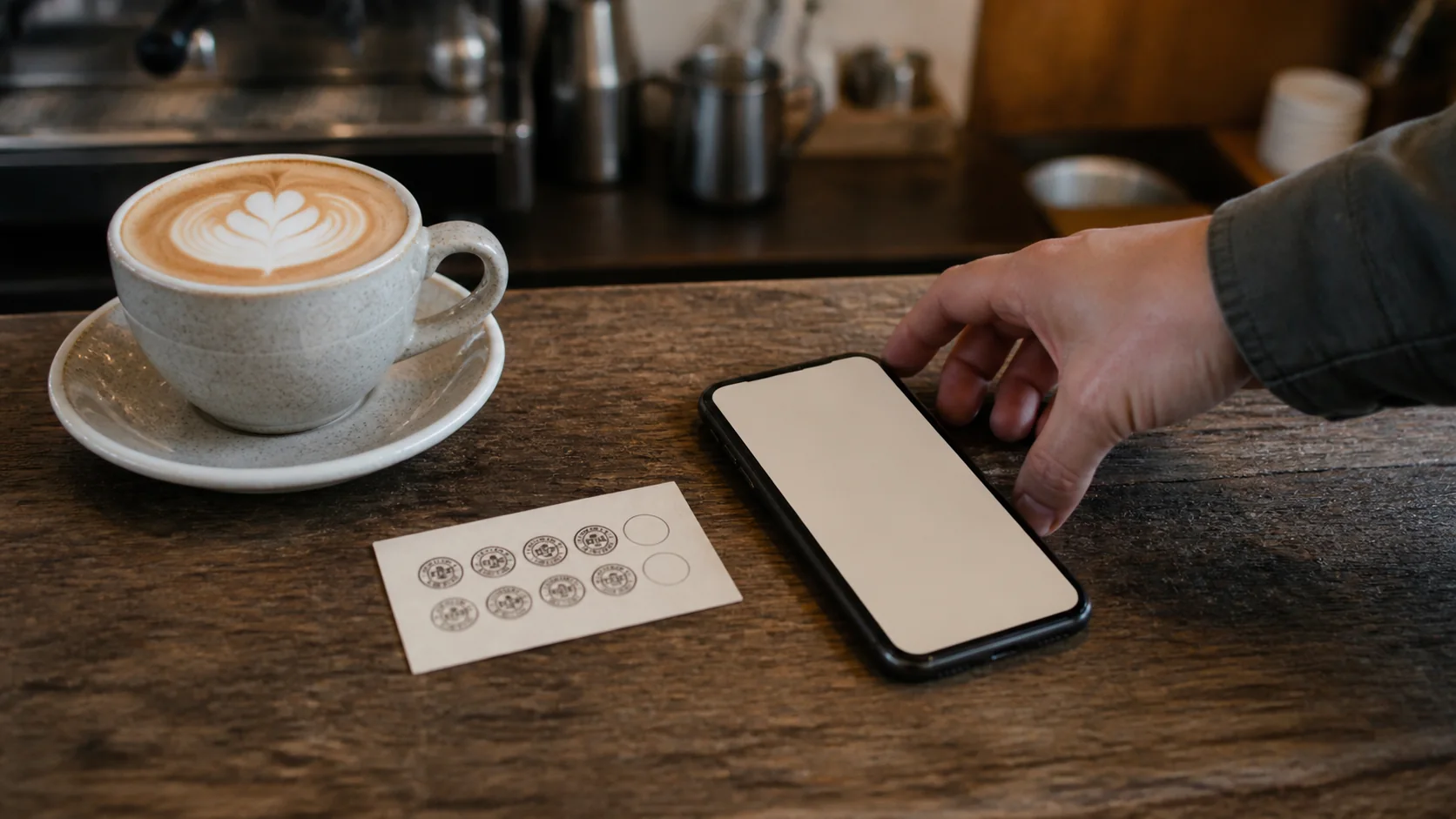
Paper is not automatically outdated, and digital is not automatically better. A paper card can be the right low-cost test for a straightforward reward. A digital card becomes useful when the café needs reliable progress, customer-level visit history, controlled corrections, insight or an appropriate way to communicate.
The short answer
Choose a paper loyalty card when you need the cheapest, fastest trial and can accept limited measurement. Choose a digital loyalty card when lost cards, misuse, customer insight, messaging or multi-staff consistency are important enough to justify software and a phone-based workflow.
| Decision | Paper card | Digital card |
|---|---|---|
| Initial setup | Design, print and physical stamp | Configure card, customer join and staff access |
| Customer storage | Wallet, pocket or behind counter | Customer’s phone or wallet, depending on provider |
| Staff action | Physical stamp or punch | Scan, POS action or digital confirmation |
| Lost progress | Usually lost with the card | Remains connected to the account/profile |
| Corrections | Cross out, replace or rely on judgement | Authorised correction can remain in activity history |
| Customer insight | Minimal or none | Visits, progress and rewards may be measurable |
| Messaging | Not built in | Possible with appropriate preferences and provider features |
| Ongoing cost | Reprints and staff handling | Subscription, setup and possible usage/add-on fees |
| Dependency | Cards and stamp must be available | Device, service and internet availability |
Setup and launch
Paper
A paper programme needs artwork, printed stock, a stamp or punch and a written rule. The cheapest version can launch quickly, but speed should not replace reward maths and terms.
Before printing, decide:
- eligible purchase;
- number of stamps;
- exact reward;
- expiry, combining and refund rules; and
- how a disputed or damaged card is handled.
Use our free coffee shop loyalty card template to test the rule before placing a large print order.
Digital
A digital programme adds decisions about customer joining, account access, staff permissions, privacy information, message preferences and what happens when a screen or connection fails.
Ask the provider to demonstrate:
- first-time join;
- later visit;
- normal stamp;
- correction;
- completed reward;
- staff access removal; and
- customer data export or deletion.
The Loytap flow uses a café join QR, a personal customer QR and a supported staff phone rather than a till integration.
Counter speed
Paper can be very fast when the card is already in the customer’s hand and the stamp is beside the till. It becomes slower when customers search through a wallet, staff keep cards behind the counter or several similar cards must be matched to names.
Digital can be fast when the customer knows where the card lives and the staff action is designed for one scan. It becomes slow when the customer must download an app in the queue, sign in again or find a code buried inside a complicated interface.
The only reliable comparison is a live test. Time the second visit—not just the polished signup demo.
Lost cards and continuity
Paper progress normally belongs to the physical card. A café can choose to replace a lost card based on goodwill, but that creates inconsistent decisions and no reliable evidence.
Digital progress belongs to the customer account or profile. Losing a phone should not necessarily erase the history, although the exact recovery flow depends on the provider.
This is one of digital’s clearest advantages: continuity without asking staff to reconstruct stamps from memory.
Misuse and corrections
Neither format is fraud-proof.
Paper stamps can be copied, cards combined against the rules or rewards claimed after unclear alterations. Digital systems can be misused through shared accounts, exposed staff access or weak redemption controls.
A useful digital system should:
- restrict who can add or remove progress;
- show the correct customer before confirmation;
- distinguish a stamp from a reward redemption;
- allow authorised correction; and
- keep enough activity history to investigate a mistake.
Do not advertise “fraud prevention” as if misuse becomes impossible. Describe the actual controls.
Customer data and privacy
A paper card can work without identifying the customer. That is a privacy advantage when the café does not need a profile, but it also prevents customer-level measurement.
A digital programme processes personal data. The café needs to understand what it collects, why, how long it keeps it, who processes it and how the customer exercises their rights. Electronic marketing may require separate consent under the Privacy and Electronic Communications Regulations, depending on the message and relationship.
Use the UK Information Commissioner’s guidance for direct marketing as an authoritative starting point. Software features do not remove the café’s responsibility.
Collect the minimum information required for the programme. A birthday field can support a birthday reward, but that does not justify collecting a full customer profile nobody will use.
Insight and measurement
Paper can reliably show cards completed and rewards redeemed if the café collects completed cards and counts them. It cannot normally show:
- how many issued cards belong to active customers;
- time from joining to second visit;
- average time to reward;
- customers close to the target;
- members whose activity has gone quiet; or
- differences between joining and returning.
Digital records can support those measures. That does not mean the programme caused every return. Weather, product, location, service, price and season all influence visits.
Use digital data to ask better questions, not manufacture certainty.
Messaging
Paper has no built-in communication channel. The café can collect an email separately, but the loyalty card itself does not provide relevant visit context.
Digital systems may support reward reminders, event updates, service messages or win-back campaigns. The useful distinction is not “can it send?” but:
- Can the owner choose a relevant customer or live group?
- Can the recipient list be reviewed?
- Are marketing preferences respected?
- Is unsubscribe straightforward?
- Does the message have a genuine reason?
Loytap’s customer messaging starts with the profile or group and keeps the owner in control of the final send.
Cost comparison
Paper costs
- design;
- print volume and reprints;
- stamp or punch;
- cards discarded or replaced;
- staff handling; and
- reward leakage through inconsistency or copied stamps.
Digital costs
- subscription;
- setup or branding, if charged;
- devices or POS requirements;
- usage, location, staff or message fees;
- training and support; and
- time spent reviewing data and customer preferences.
Compare a realistic 12-month total. A £0 software plan may still involve staff, branding or customer-experience trade-offs. A flat paid plan may be poor value if the café never uses the insight it provides.
Brand and customer experience
Paper gives the café complete visual control, within the limits of a small card. A digital provider may offer:
- a fully café-branded web card;
- an Apple or Google Wallet pass;
- a profile inside a shared consumer app; or
- loyalty embedded in the POS receipt and checkout.
None is universally best. Ask where customers see the provider brand, whether other businesses appear, and how they reopen the card on visit two.
Reliability and fallback
Paper works without electricity or internet but fails when the card or stamp is missing. Digital works across devices and can preserve history but depends on a supported screen, staff access and service availability.
Write a fallback rule before launch. For example: retain the receipt and add the verified stamp later, or record the customer details securely for a supervised correction. Do not improvise a different policy on every shift.
When paper is the right choice
Use paper when:
- you are testing one simple reward;
- budget is the overriding constraint;
- customer identification is unnecessary;
- one location and a small team apply the rule consistently; and
- completion/redemption counts are enough for the first decision.
When digital is the right choice
Use digital when:
- lost cards create regular friction;
- the café wants a customer to keep progress on their phone;
- staff corrections and access need control;
- repeat-visit insight will inform decisions;
- relevant messaging is part of the plan; or
- the programme needs consistent records across more people or locations.
A low-risk migration plan
- Keep the same eligible purchase and reward at first.
- Explain why the card is changing in one sentence.
- Give paper customers a fair transition window.
- Do not transfer unverifiable stamps automatically without a stated policy.
- Train the second-visit scan and failure fallback.
- Record the launch date and baseline.
- Review join, second visit, active use, completion and redemption after a fixed period.
A digital programme should make the familiar mechanic more reliable, not bury it under software. See the actual Loytap digital stamp card and coffee shop loyalty programme to decide whether that added customer context is worth it for your café.